
How the compliance foundation works
Usually two focused sessions, for a fixed fee
You finish with a clear picture of everything that applies to your charity, the documents that were missing, and a board that understands why.
This is one of the four ways we work with charities, and the one most boards start with. See the full charity offering.
The approach
Built up with you, not marked down against a checklist
The traditional governance review hands a charity a long list of everything it does not have. It is rarely proportionate, rarely explained, and usually ends up in a drawer. This works the other way round: it begins with what the law genuinely requires of a charity with your structure, income and activities, each with its legal basis in plain English, and builds from there. The result is a document map your board has agreed and owns, not a deficit report it has been handed.
Guidance stays inside a defined framework of more than 70 Acts and regulations of Scottish and UK law, and never strays outside it. An adviser guides the conversation throughout, and nothing proceeds until you have confirmed it reflects your charity.
Your charity, confirmedStructure, income, activities, people. We prepare a profile beforehand and you check it before anything else happens.
What applies, mappedWhat the law requires of your charity, and what is worth a conversation, each with the reason. Nothing is pre-selected. Query an item and the question and answer are recorded.
The missing pieces, draftedDocuments written to fit your charity and discussed with you as they are written.
Your board planEach document placed into your board’s meetings, the regulator’s dates alongside, and every session recorded.
What to expect
The foundation usually takes two focused sessions of around two hours each. Before the first, we prepare a profile of your charity and ask you for a few things: your governing document, what you do and who you work with, whether you employ anyone, and any policies you already have. You do not need to have read any regulatory guidance. That is what the sessions are for.
The sessions stay focused on getting your foundation in place. They work best with the same people at both: a trustee, and someone with day-to-day knowledge of your activities. Wider questions often come up along the way, about a trustee, a funder or a difficult decision. We note each one for your board rather than let it take over the session.
Sessions run online via Teams or a similar platform, or in person if your charity is in the central belt of Scotland. The fee covers getting your foundation in place, not a count of hours. If a further session turns out to be needed, we agree it, and any cost, with you first.
The six areas we work through
Charity duties do not arrive in one list. They come from the regulator, from employment law, from data protection, from health and safety, and from whatever your charity actually does. We work through it area by area and set out what applies, what does not, and why. What is shown under each area is an illustration only, not a checklist, and not what any particular charity needs.
Governance, leadership and ethics
How the board is made up, how it takes decisions, and how it handles the things that test a charity: a conflict of interest, a complaint, a serious incident.
People, culture and safeguarding
Everyone who acts for your charity, paid or unpaid. What you owe them, what you ask of them, and how you keep the people you work with safe.
Finance, fundraising and resources
Where the money comes from, who can commit it, and how the board can show it was handled properly.
Data, information and technology
The personal information you hold, and the systems you hold it on.
Operations, health and safety
The practical business of running activities safely, in your premises or out in the community, plus anything your particular activity brings with it.
OSCR compliance and reporting
What the regulator expects each year, and what has to be told to it when things change.
Outputs
What you leave with
Everything is produced during the sessions themselves. There is no waiting for a report to be written. Each one below links to a sample you can open, from a session run on a test charity.
Your documents and board plan
One file your board keeps and works from. It shows every document that applies to your charity, grouped by topic, and where each one stands. It then places each document into your board’s meetings: the board records what it decided at each meeting, anything deferred moves to the next, and each document comes back when its review is due, with the regulator’s dates set alongside. The file stays on your own computer and is yours to keep up to date.
Try it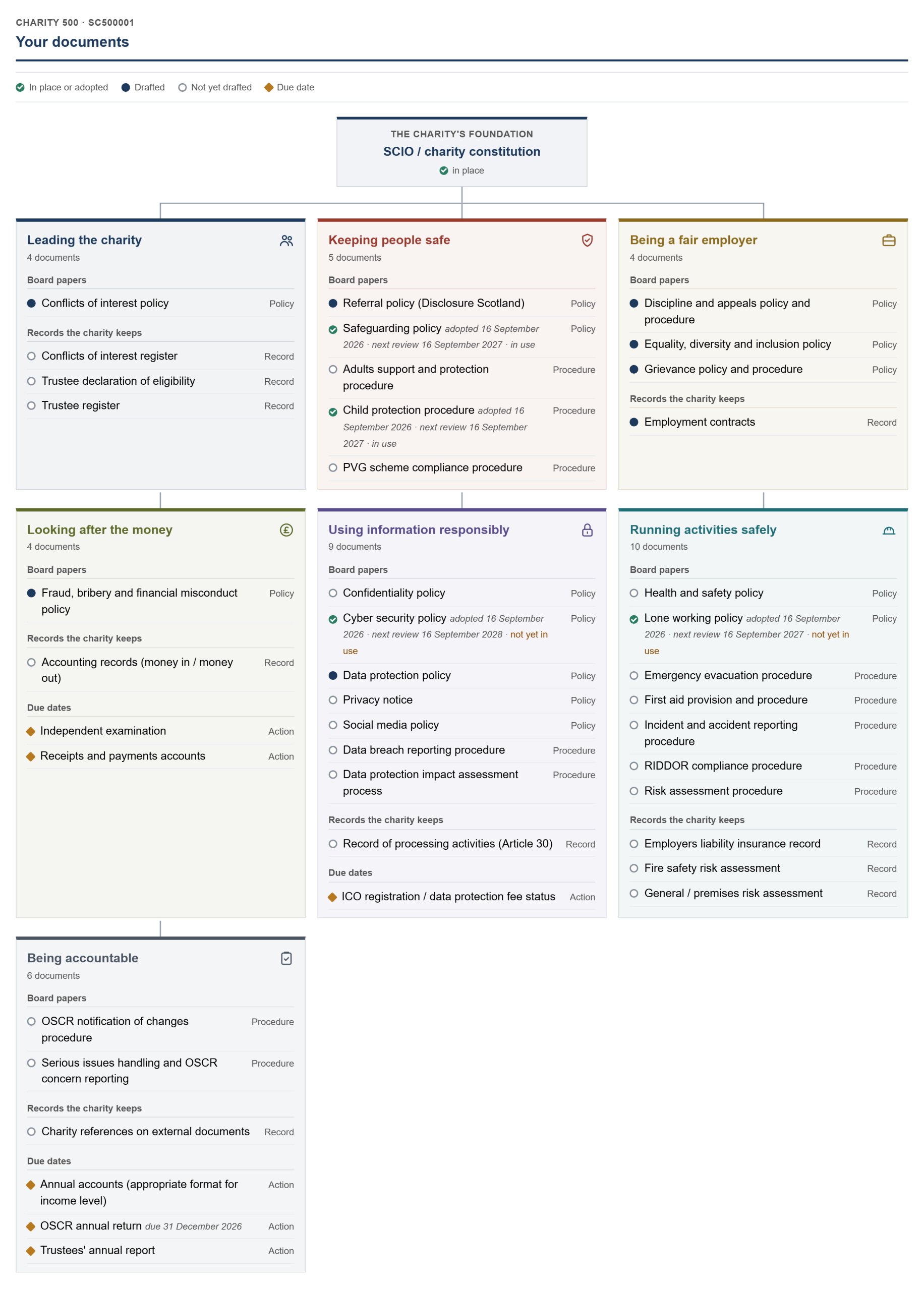 Try the working exampleOpen it here: move papers, record decisionsDownload itThe file itself, to open in your browser
Executive Review
A plain-English narrative covering all areas discussed, anchored to the map you agreed, with your position set out and the five to seven things to do first. It also records what the board chose not to prioritise and why, because a deliberate decision not to act is itself evidence of considered governance.
See an example Executive review5 pages. What was agreed, and what happens next
Compliance Guidance pack
A plain-English reference gathering the guidance given across every area discussed, organised by topic and with the relevant diagrams included. A keepable resource your trustees, senior staff and volunteers can return to, not a one-off conversation.
See an example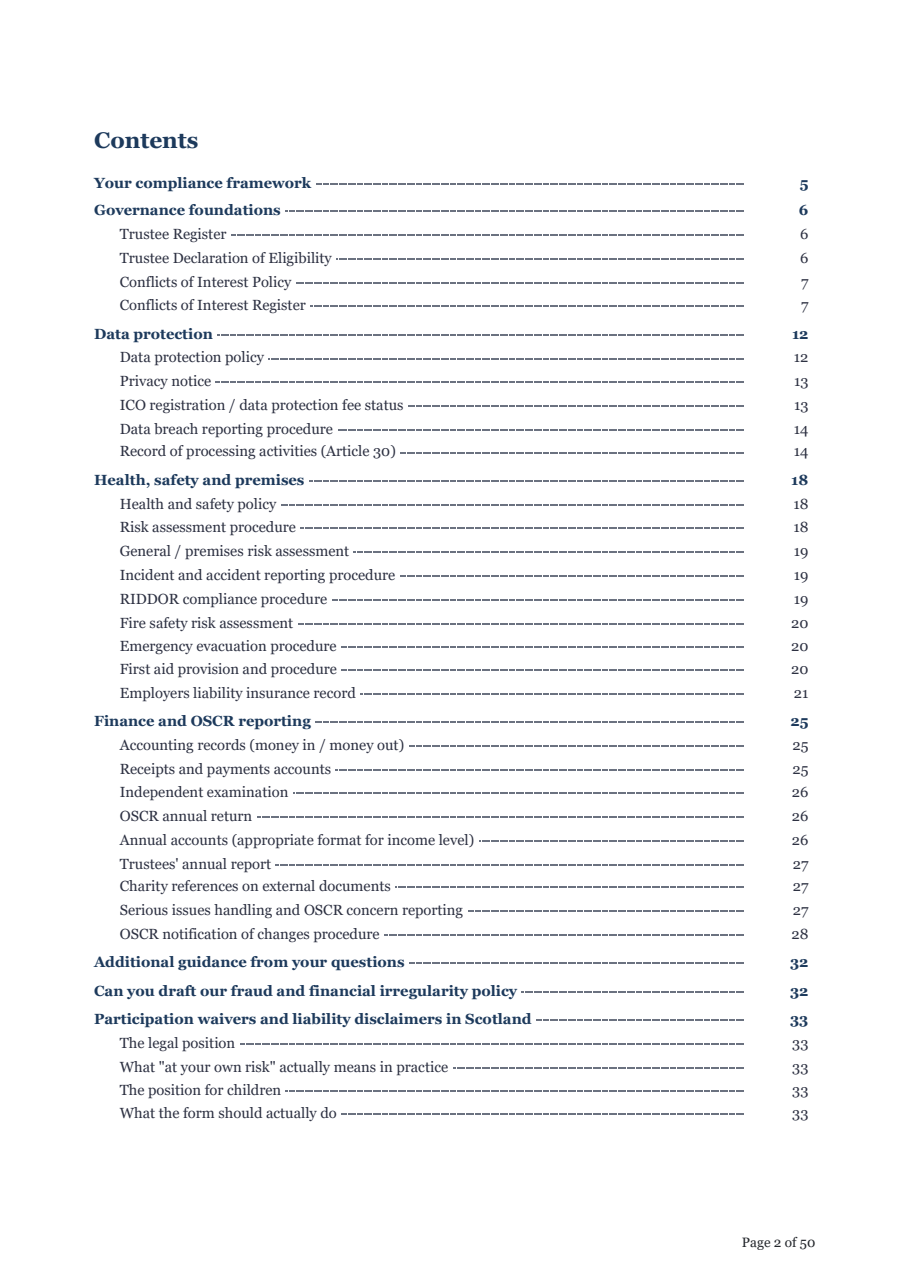 Guidance packCover and contents of 50 pages
Adopt-ready policy documents
For the items you agreed to build, the engine drafts policies tailored to your charity, exported as editable Word documents your board owns. These are starting points to review, adapt and adopt, not templates to file away.
See examples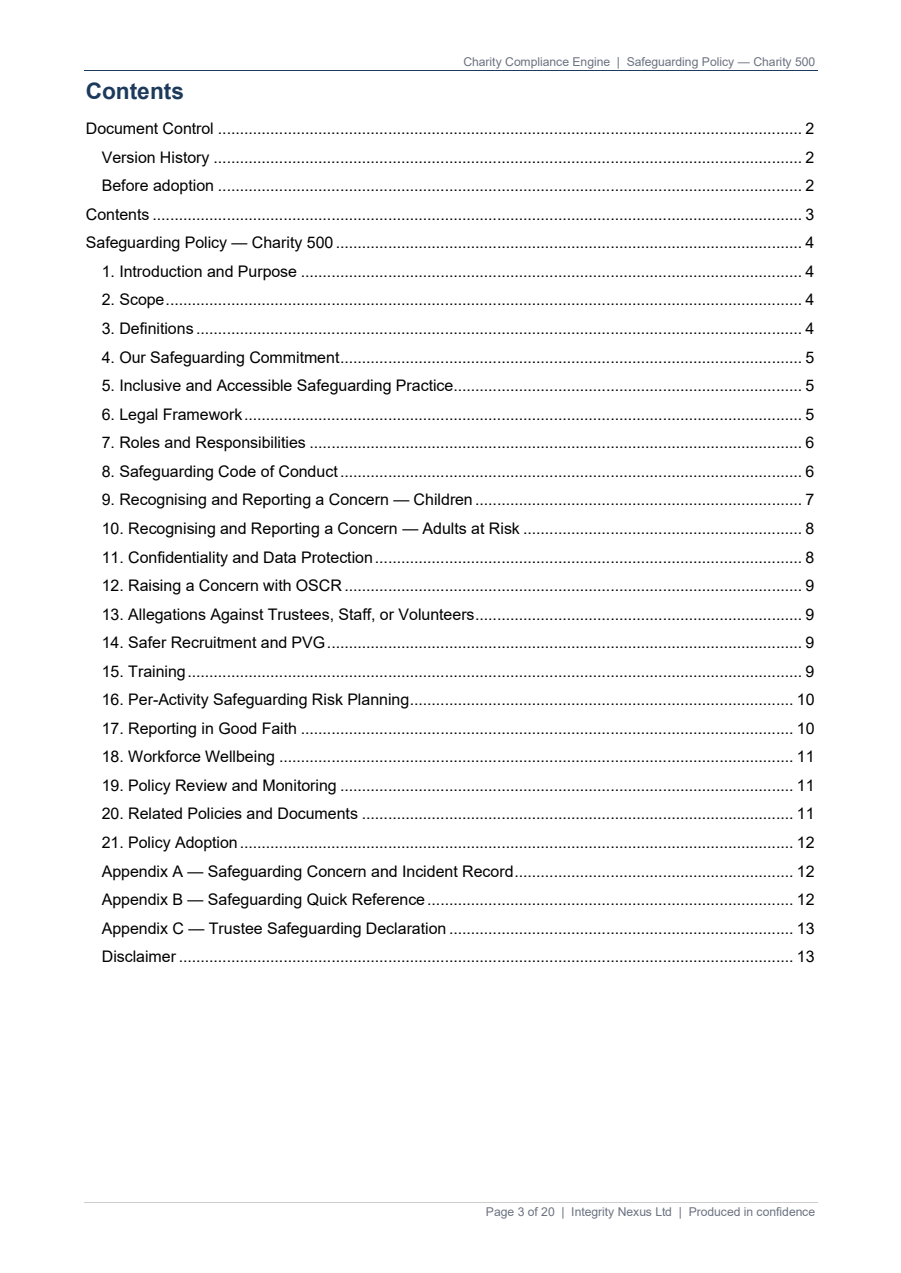 Safeguarding policy25 sections across 20 pages
 Child protection procedure21 sections across 17 pages
 Referral policy (Disclosure Scotland)13 sections across 12 pages
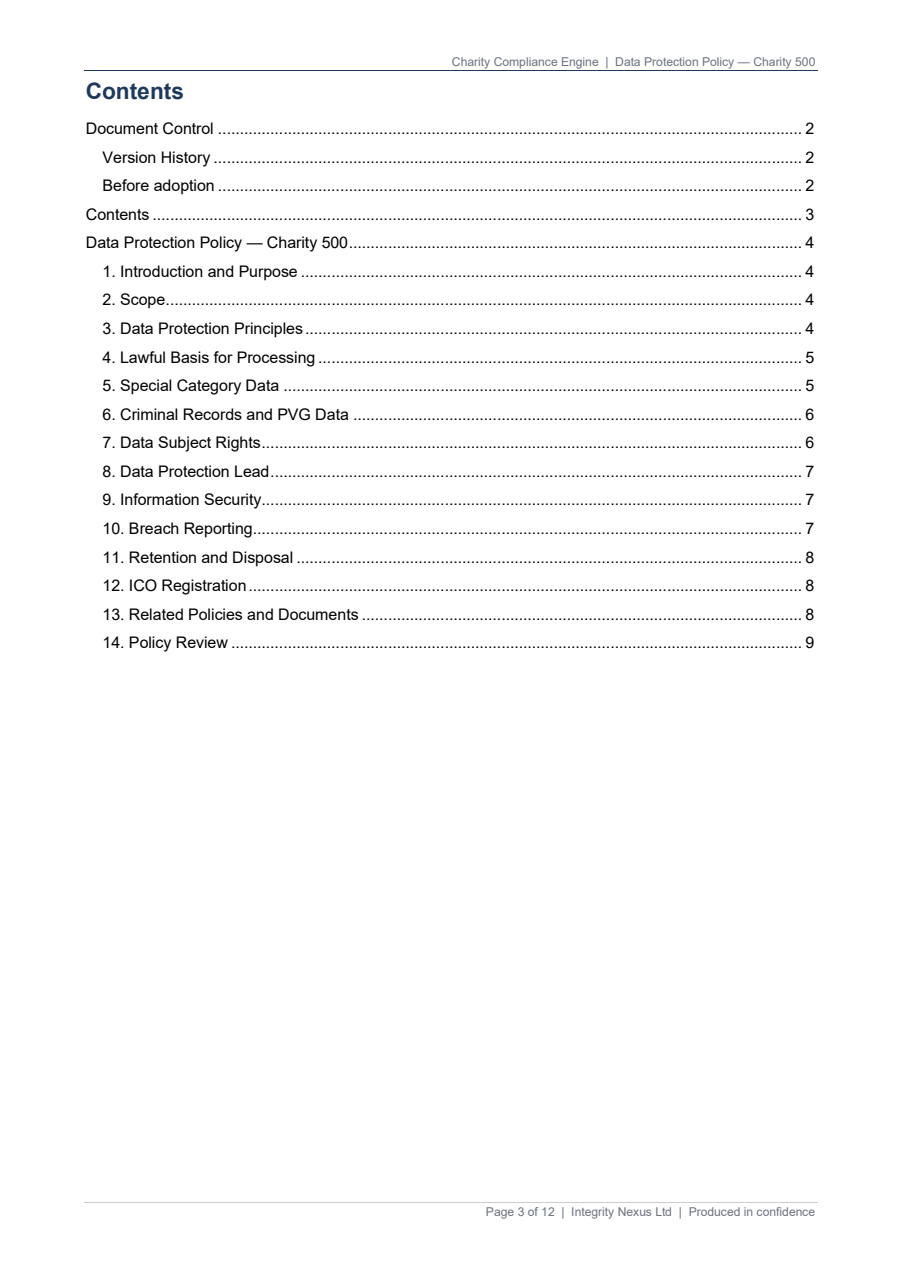 Data protection policy14 sections across 12 pages
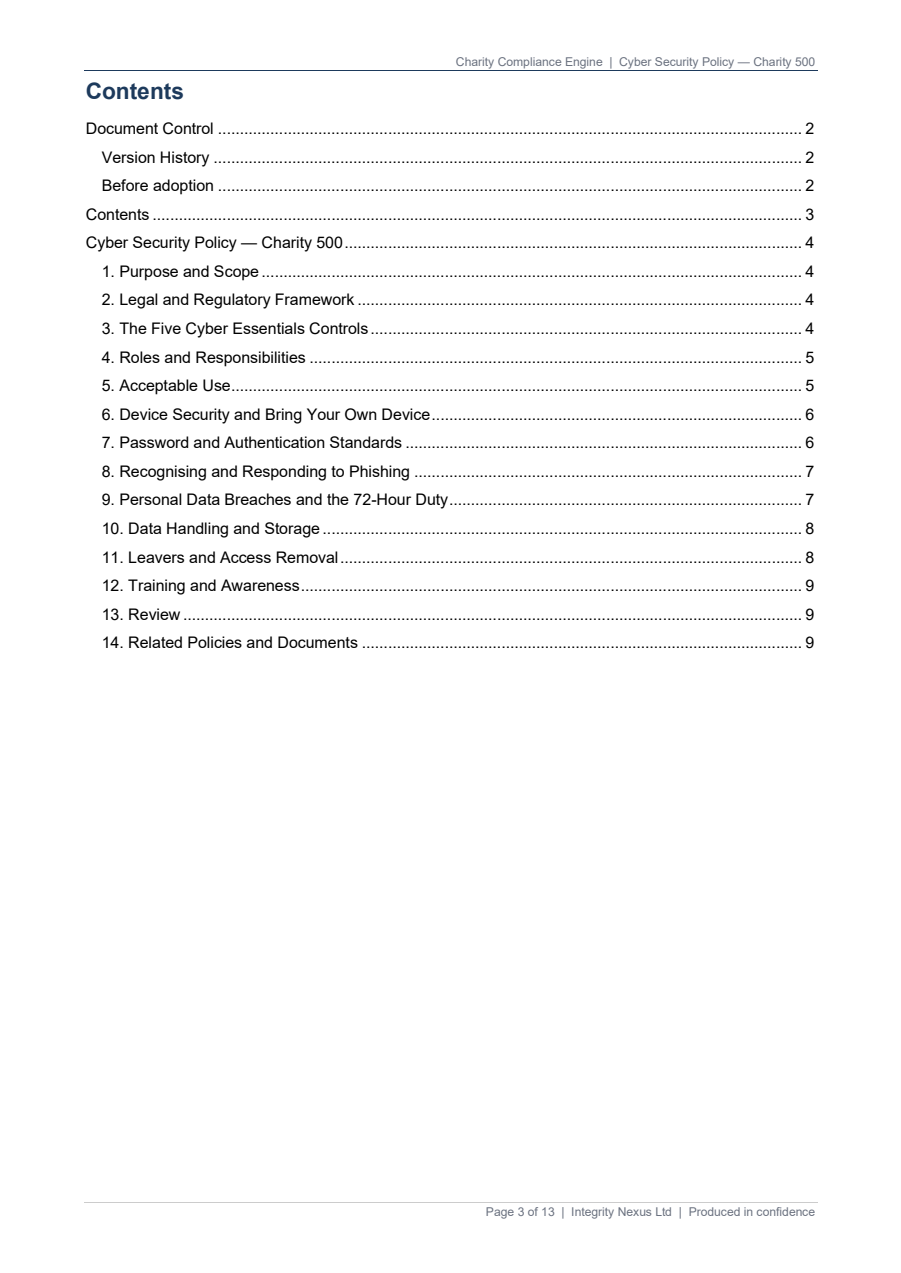 Cyber security policy14 sections across 13 pages
The full session record
Everything that was asked, everything that was answered, and every document drafted, as one PDF. This is what you reach for when a funder or a new trustee asks months later how a decision was reached.
See an example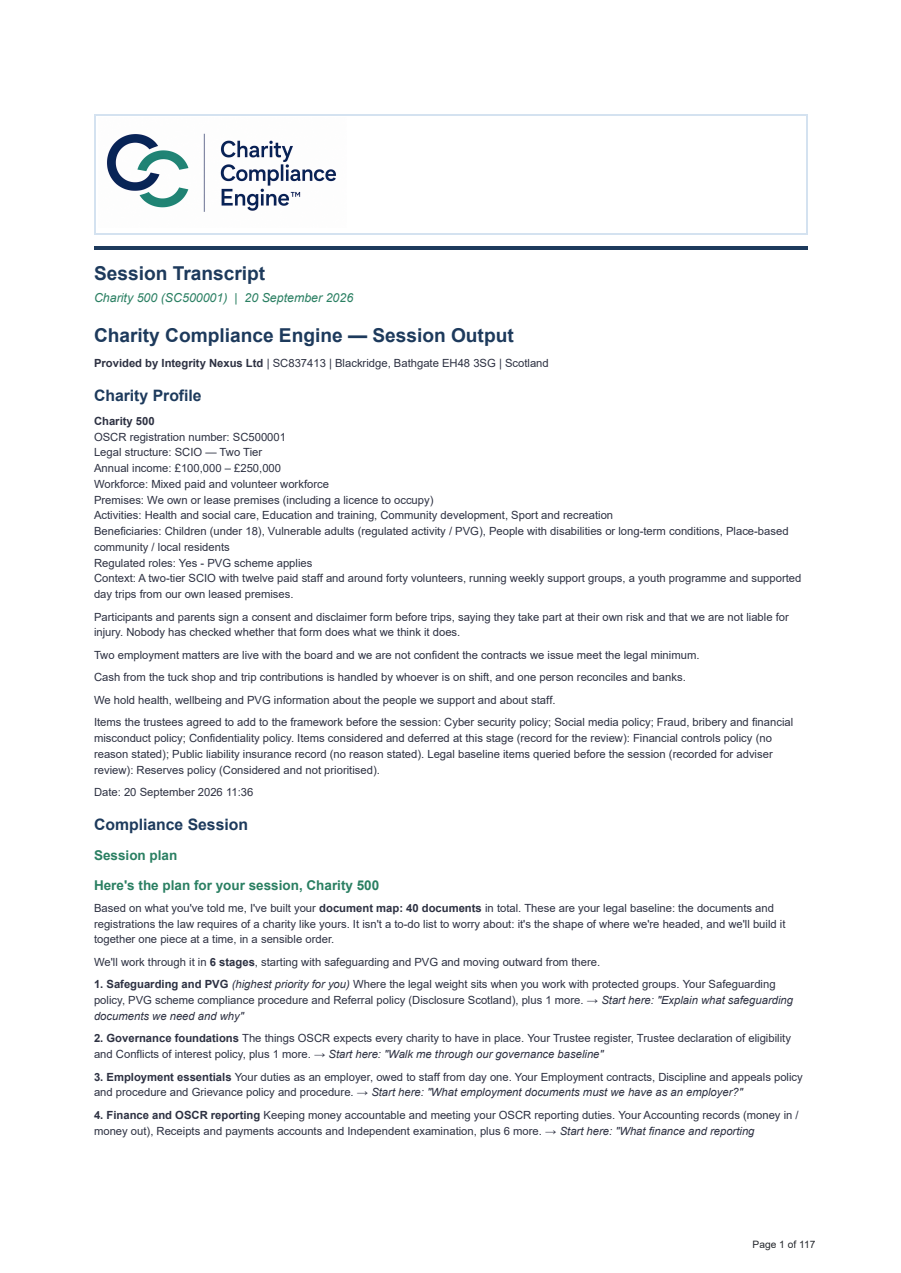 Session recordFirst page of 117. The charity profile
These are illustrative samples. They are built around Charity 500, a test charity, so the scope and structure are real while no charity’s own documents are published. A charity with different work, different people and different premises gets a different pack.
Same journey, different charity
Your map is yours. No size bands, no generic list.
Two charities, the same six areas, the same foundation. What comes out is not a longer or shorter version of the same pack. It is a different pack, because a different part of the law reaches them.
A care and learning charity
Illustrative example
- Governance, leadership and ethics
- Constitution in place. Trustee register, eligibility and conflicts still to put in place.
- People, culture and safeguarding
- Safeguarding, child protection, Disclosure Scotland referrals, employment contracts, discipline, grievance, lone working.
- Finance, fundraising and resources
- Fraud and financial misconduct drafted. Independent examination and reserves discussed.
- Data, information and technology
- Data protection and cyber security drafted. Privacy notice and breach reporting next.
- Operations, health and safety
- Its own premises, so fire safety, first aid and risk assessment all apply.
- OSCR compliance and reporting
- Annual return and trustees’ annual report, in the right format for its income.
A volunteer-run community group
Illustrative example
- Governance, leadership and ethics
- Trustee register, eligibility declaration, conflicts policy and register, all drafted.
- People, culture and safeguarding
- A volunteer policy. No employment duties and no PVG scheme duties, because nobody is employed and nobody does regulated work.
- Finance, fundraising and resources
- Accounting records, receipts and payments accounts, independent examination, reserves.
- Data, information and technology
- Privacy notice and breach reporting. The same duties apply at any size.
- Operations, health and safety
- A hired hall, so health and safety and evacuation still apply, scaled to how it actually operates.
- OSCR compliance and reporting
- Annual return, trustees’ annual report, charity references, what to tell OSCR when things change.
After the foundation
Your board adopts it, at its own pace
Your board reviews, adjusts and formally adopts the documents over the following months, working through the board plan, which records each decision and brings every document back when its review is due. If questions come up later, you can come back to an adviser who already knows your charity. See ongoing advice and the other ways we work with charities.
Ready to find out if it is right for your charity?
Get in touch and we will talk through whether the compliance foundation is right for your charity, and what it would cost, or see the other ways we work with charities.